
Hi, I'm Shawn M.. I live in Ohio.
Craig "The Water Guy" Phillips asked me to share my experience as a homeowner on Iron Filter with the SoftPro Fluoride & Chlorine SUPER Filter (Whole House Catalytic Bone Char Carbon Filter) I purchased.
This is how my adventures played out. I hope this helps you in your decision.
Did you know that municipal water treatment facilities are legally required to add chlorine to kill bacteria, but they're not required to remove it before it reaches your tap? I certainly didn't know this eight months ago when I started noticing that our "clean" city water was leaving white residue on dishes, making our morning coffee taste like a swimming pool, and causing my wife's sensitive skin to break out after showers.
What started as mild annoyance with our water quality turned into a full-blown research project that led me to invest in the SoftPro Whole House Upflow Catalytic Bone Char Carbon Filter. After living with this system for eight months, I can honestly say it's been one of the best home improvements we've made – though the journey had its learning moments.
The Water Problems That Finally Pushed Me Over the Edge
Living in central Ohio, I always assumed our municipal water was perfectly fine. The city sends those annual water quality reports that show everything meets EPA standards, so what could be wrong?
The wake-up call came during a particularly hot summer when our chlorine levels seemed higher than usual. My morning ritual of grinding fresh coffee beans and brewing a perfect cup was being ruined by an overwhelming chemical taste. No matter what premium beans I bought, everything tasted like it had been filtered through a public pool.
But the coffee was just the beginning. My wife Sarah started complaining about dry, itchy skin after showers. Our 10-year-old daughter Emma's eczema, which had been manageable, suddenly flared up worse than we'd seen in years. Even our pets seemed to prefer drinking from puddles outside rather than their indoor water bowls.
The final straw was discovering white, chalky buildup inside our relatively new dishwasher's spray arms. When I called the appliance repair service, the technician took one look and said, "Hard water and high chlorine. You need a whole house filter, or you'll be replacing appliances every few years."
That conversation cost me $150 in service fees and sparked a three-week deep dive into water treatment options. I tested our water with a TDS meter and found levels around 320 parts per million – not terrible, but definitely in the "hard" category. The chlorine smell was obvious, but I learned that what I was smelling was actually chloramine, a more stable disinfectant that many cities use because it doesn't dissipate as quickly as regular chlorine.
I tried pitcher filters first, thinking I could solve the drinking water issue affordably. After spending $40 a month on replacement cartridges that barely kept up with our family's consumption, I realized I was treating symptoms instead of the source.
Research Journey: Why I Chose Catalytic Carbon Technology
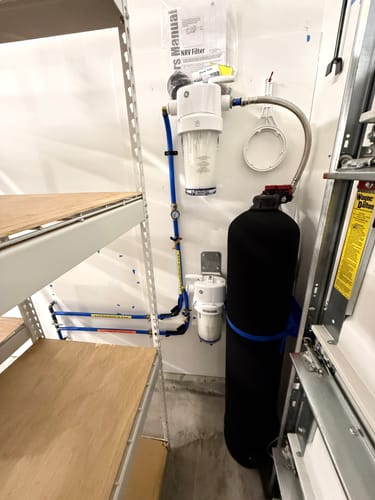
My research phase consumed evenings and weekends for nearly a month. I'm the type of person who reads Amazon reviews until my eyes blur, watches YouTube installation videos for products I haven't even decided to buy, and creates spreadsheets comparing specifications.
Initially, I thought a basic carbon filter would handle everything. Carbon removes chlorine and improves taste – how complicated could it be? But as I dug deeper, I learned about the limitations of standard granulated activated carbon (GAC) filters.
Regular carbon filters work great for chlorine, but they struggle with chloramine. Since our city uses chloramine, I needed either a much larger standard carbon filter or a specialized catalytic carbon system. The catalytic carbon acts as a catalyst to break down chloramine into ammonia and chlorine, which are then absorbed by the carbon media.
The bone char component was initially confusing to me. Bone char carbon, made from cattle bones heated in oxygen-free environments, has a unique porous structure that's particularly effective at removing fluoride and certain heavy metals. While our city doesn't add excessive fluoride, the bone char also provides additional chloramine reduction capacity and helps with trace contaminants that regular carbon might miss.
Why specifically the SoftPro system?
Several factors made this system stand out during my research:
The upflow design means water enters at the bottom and exits at the top, ensuring maximum contact time with the media. Downflow systems can create channeling where water finds the path of least resistance, reducing filtration effectiveness.
The built-in bypass valve was crucial for me. Living in Ohio, we occasionally have municipal water work or emergencies where I might need to temporarily bypass the filter. Having this built into the system head saves installation complexity and future headaches.
The catalytic carbon and bone char blend provides multi-stage filtration in a single tank. Some systems require separate tanks for different media types, but this combination approach saves space in my utility room while providing comprehensive treatment.
NSF certification for the components gave me confidence in the performance claims. While the assembled system doesn't carry NSF certification as a complete unit, the individual media and tank components meet NSF standards for their respective applications.
The 5-year media life expectancy and reasonable replacement costs made the long-term economics attractive compared to annual filter changes required by some systems.
Unboxing and First Impressions: Better Than Expected
When the freight truck delivered my system on a Tuesday morning in March, I was surprised by the professional packaging. The fiberglass tank arrived wrapped in foam padding inside a custom cardboard cradle, while the electronic control head was separately boxed with foam inserts.
The Pentair Structural fiberglass tank felt substantial – not the lightweight plastic I'd feared based on online photos. At roughly 120 pounds when filled with media, this isn't something you want to move around frequently, but the weight actually reassured me about durability.
The Fleck 5600SXT control head looked more sophisticated than I expected. The digital display was clear and intuitive, and the programming manual was actually readable – a pleasant surprise after dealing with some home appliance manuals recently.
What impressed me most was the inclusion of a tank insulation sleeve. This wasn't mentioned prominently in the product description, but it prevents condensation in humid conditions and provides some freeze protection in unheated spaces. Since my utility room can get chilly in winter, this was a thoughtful addition.
The installation fittings were high quality – brass and stainless steel components rather than plastic. Everything felt like it was designed for long-term operation rather than just meeting a price point.
Installation Experience: Easier Than Anticipated

I'll be honest – I was nervous about the plumbing modifications required. My DIY skills are decent, but I'd never cut into my main water line before. After watching several installation videos and consulting with a plumber friend, I decided to tackle it myself with his guidance.
The most challenging part was determining the optimal location. The system needs to be after your main shutoff and pressure tank (if you have a well), but before your water heater and any branch lines you want filtered. I chose a spot in our utility room about six feet from where the main line enters the house.
Cutting the copper pipe and installing the bypass valve took about an hour, including time spent double-checking measurements. The bypass valve requires three pipe cuts and six solder joints, but having the valve integrated into the system head simplified the plumbing compared to installing a separate bypass loop.
Mounting the control head was straightforward – four lag bolts into wall studs. The tank sits on the floor next to it, connected by flexible stainless steel hoses that come with the system.
The electrical connection requires a standard 110V outlet for the control head. I ran a new dedicated circuit from my panel, but you could use an existing outlet if it's properly grounded and has adequate capacity.
Initial system startup involves a series of backwash and rinse cycles to remove carbon dust and settle the media bed. This process took about two hours and used approximately 100 gallons of water – something to consider if you're on a well or pay for sewer based on water usage.
The programming interface was more intuitive than I expected. Setting up regeneration schedules, adjusting flow rates, and configuring the bypass functions took maybe 20 minutes with the manual open.
Performance Results: The Numbers Don't Lie
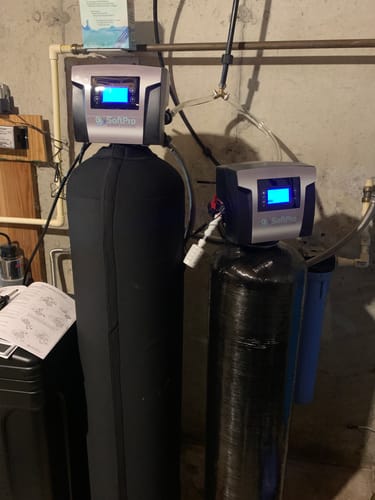
I'm a bit obsessive about measuring things, so I documented our water quality before and after installation using a combination of test strips, a digital TDS meter, and a chlorine test kit I bought from a pool supply store.
Before Installation (March baseline):
Total Dissolved Solids: 315-340 ppm
Free Chlorine: 0.5-0.8 ppm
Total Chlorine (including chloramine): 1.2-1.8 ppm
pH: 7.4-7.6
Hardness: 12-14 grains per gallon
After Installation (measured at 2 weeks, 3 months, and 8 months):
Total Dissolved Solids: 290-310 ppm (modest reduction)
Free Chlorine: 0.0 ppm consistently
Total Chlorine: 0.0-0.1 ppm
pH: 7.5-7.7 (minimal change)
Hardness: 11-13 grains per gallon (carbon doesn't remove hardness)
The chlorine and chloramine removal has been absolutely consistent. Even during summer months when the city increases disinfectant levels, I haven't detected any breakthrough. The taste and odor improvement was immediate and has remained constant.
What surprised me was the modest TDS reduction. I learned that TDS includes beneficial minerals that carbon filtration doesn't remove, so the small decrease likely represents removal of some dissolved organic compounds rather than essential minerals.
Flow rate through the system measures about 15 GPM during regeneration and unrestricted flow during service – no pressure drops noticeable during normal household use, even with multiple fixtures running simultaneously.
Real-World Performance Testing:
Coffee taste improvement was dramatic and immediate. The chemical aftertaste completely disappeared, and I could actually taste the differences between coffee bean origins again.
Dishwasher performance improved gradually over about six weeks as existing mineral deposits dissolved. New spots stopped forming immediately, but it took time for the cleaning cycles to remove accumulated buildup.
Skin and hair improvements were noticeable within the first month. Sarah's post-shower skin irritation resolved almost completely, and Emma's eczema calmed down significantly. Even I noticed less dryness during Ohio's harsh winter months.
Daily Living Impact: The Subtle and Not-So-Subtle Changes
Eight months in, the most striking thing is how I don't think about our water anymore. Before installation, I was constantly aware of water quality issues – from morning coffee disappointments to evening shower discomfort. Now, water just works the way it should.
Kitchen Improvements:
Cooking with filtered water has enhanced flavors we didn't realize were being masked. Rice, pasta, and soups taste cleaner and more vibrant. Ice cubes are crystal clear instead Fluoride Filter System of cloudy, and they don't carry any chemical odors that used to affect cold drinks.
Our coffee maker hasn't developed any new mineral scaling, and the last descaling cycle required much less vinegar than usual. I estimate this is saving us $50-75 annually in appliance maintenance and coffee quality.
Bathroom Benefits:
Shower experiences are noticeably different. The water feels softer on skin, though technically it's not soft water – it's just free from chloramine that was causing dryness. Hair feels less brittle, and Sarah has reduced her conditioner usage.
Cleaning bathroom fixtures requires less scrubbing. While we still get some mineral spots (this isn't a water softener), the spots are easier to wipe away and don't build up as quickly.
Laundry Improvements:
Clothes feel slightly softer and colors seem more vivid. This might be subtle, but side-by-side comparisons with identical items washed before and after installation show noticeable differences. We've also reduced fabric softener usage by about half.
Unexpected Discoveries:
Our houseplants are thriving. I hadn't considered that chloramine might stress plants, but several struggling houseplants have shown remarkable improvement since switching to filtered water.
Pet behavior changed too. Our cats now drink regularly from their indoor bowls instead of seeking outdoor water sources. This has been especially beneficial during winter months.
Guests comment on water taste when visiting. Several friends have asked about our water source, assuming we have well water because of the clean taste.
Operating Costs and Long-Term Value Analysis
Understanding the true cost of ownership was crucial for justifying this investment to my budget-conscious wife. Here's what I've learned after eight months of operation:
Initial Investment Breakdown:
SoftPro system with shipping: $1,247
Installation supplies (fittings, solder, wire): $85
Electrical work (DIY): $45 in materials
Total initial cost: $1,377
Monthly Operating Costs:
Electricity for control head: approximately $3-4
Water for regeneration cycles: ~$8-12 (varies by local rates)
Total monthly operation: $11-16
The system regenerates based on water usage rather than a timer, so costs fluctuate with our consumption. During summer months with lawn watering (which bypasses the filter), regeneration frequency actually decreases.
Maintenance and Replacement Schedule:
Catalytic carbon and bone char media: replacement every 5-7 years at approximately $180
Control head annual inspection: DIY, no cost
Occasional injector cleaning: 10 minutes, no parts cost
Cost Comparison Analysis:
Previous pitcher filter costs: $40/month for replacement cartridges
Bottled water for drinking: $25/month average
Appliance protection value: estimated $200/year in extended life
Breaking down the numbers, our previous water treatment costs were running about $65/month between filters and bottled water. Current operating costs are $11-16/month, creating immediate monthly savings that help offset the initial investment.
The appliance protection value is harder to quantify but significant. Our dishwasher, coffee maker, and water heater should last significantly longer without constant exposure to chloramine and mineral buildup.
Return on Investment:
Monthly savings: $45-55
Payback period: approximately 26-30 months
Long-term savings over 10 years: estimated $3,500-4,200
Honest Assessment: What Could Be Better
After eight months of daily use, I can identify several areas where this system could be improved or where my expectations weren't fully met:
Space Requirements:
The system footprint is larger than I initially appreciated. The tank is 54 inches tall and 10 inches in diameter, plus the control head adds another 8 inches of width. Make sure you have adequate clearance for service access.
Regeneration Noise:
During backwash and regeneration cycles, the system produces noticeable noise – not loud enough to wake anyone, but clearly audible if you're in the utility room. The cycles typically run between 2-4 AM, so this rarely impacts daily life, but it's worth noting.
Initial Water Waste:
Startup and monthly regeneration cycles use significant water – roughly 40-60 gallons per regeneration. While this is necessary for media cleaning and extends filter life, it does increase water bills compared to cartridge systems.
Learning Curve:
The digital control interface has extensive programming options that can be overwhelming initially. While I appreciate the flexibility, simpler systems might be more user-friendly for less technical homeowners.
Installation Complexity:
Despite successfully installing it myself, this isn't a weekend DIY project for most homeowners. Professional installation would add $300-500 to the cost but might be necessary depending on your plumbing configuration.
Seasonal Performance Variations:
I've noticed slight taste differences during summer months when municipal chloramine levels increase. The system still removes chloramine effectively, but there's occasionally a very subtle taste change that suggests the media is working harder.
Limited Water Softening:
This system doesn't address hardness, so mineral spotting and soap film issues persist. While the product description makes this clear, I initially hoped for some hardness reduction. Ohio water hardness requires a dedicated softener for complete mineral management.
These limitations are relatively minor compared to the benefits, and most reflect my initial expectations rather than actual product deficiencies. Understanding these aspects upfront would help potential buyers set appropriate expectations.